

Every week, revenue teams across manufacturing and enterprise sectors gather to review pipelines, adjust targets, and manage risks. But week after week, the same problem stalls progress: forecasting is too slow, too manual, and too disconnected.
It’s not that your team lacks data - you already have Salesforce as your system of record. It’s that Salesforce alone wasn’t built for live what-if scenario planning.
This is where Valorx Wave fits in.
Wave is a spreadsheet-style interface that lets you simulate pipeline changes, pricing shifts, territory realignments, and headcount adjustments—inside Salesforce, with live data and zero disruption.
Why manufacturing revenue teams struggle with forecasting in Salesforce
Even in high-performing revenue teams, forecasting in Salesforce follows a painfully familiar pattern:

In manufacturing environments, where pricing changes, demand shifts, and regional nuances move quickly, slow forecasting equals missed opportunities and delayed decisions.
The Solution: What-if scenario planning inside Salesforce
Valorx Wave brings what Salesforce doesn’t: live, interactive scenario modeling, embedded directly inside your Salesforce org.
- No exports
- No uploads
- No disconnected spreadsheets
- Just fast, flexible, and scalable what-if modeling—right where your pipeline lives.
How to run what-if scenarios in Salesforce with Wave
With Valorx Wave, answering strategic questions becomes simple and immediate:
✅ What if this $1M deal in EMEA slips to next quarter?
✅ What happens if we increase pricing on our APAC product line by 4%?
✅ How would hiring 3 new reps in Q4 impact pipeline coverage by territory?
With Wave, you don’t need to export to a spreadsheet or build separate models. You can run what-if scenarios directly inside Salesforce, in real time, using live data.
Watch it in action
See how easy it is to model pipeline changes, pricing shifts, or territory realignments inside Salesforce.
What makes Wave different from using Salesforce alone
Salesforce gives you powerful reporting and forecasting tools, but it wasn’t designed for live modeling or interactive scenario planning.
When you try to answer "what if" questions—like shifting close dates, adjusting probabilities, or increasing deal sizes—teams often resort to spreadsheets outside the system. This creates delays, disconnected models, and more risk.
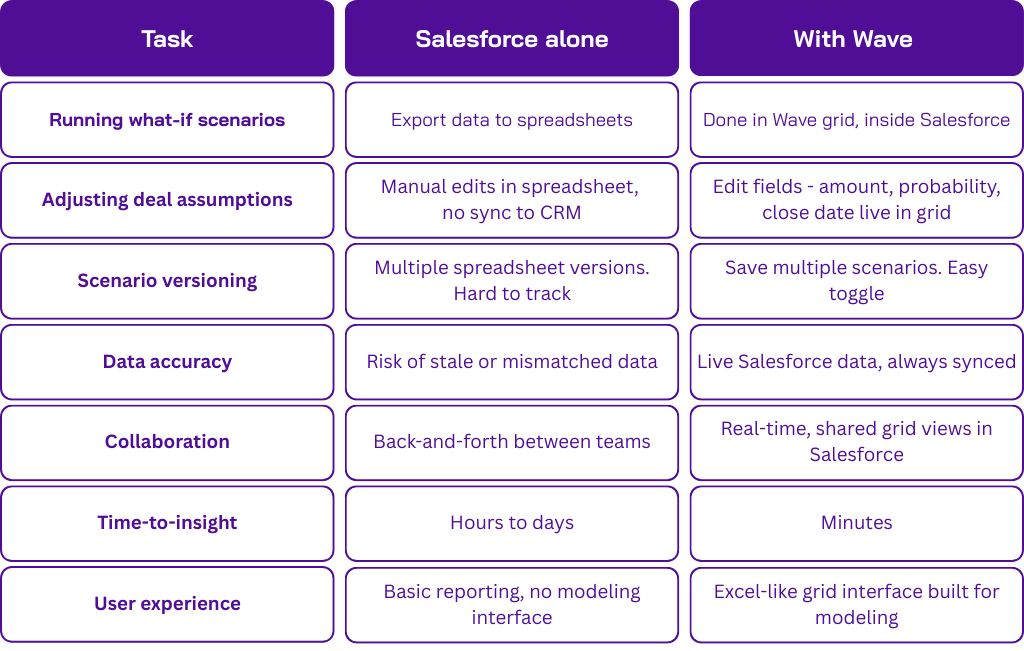
Valorx Wave bridges that gap. Here's a side-by-side view of how forecasting scenarios work in standard Salesforce workflows vs. within Wave:
Why Wave works so well inside Salesforce
Wave works with Salesforce, not around it.
- Live data sync — See changes in real time
- No local storage — All data stays in Salesforce
- Easy to learn — If you know spreadsheets, you’ll be up and running fast
- Works at scale — From small teams to global enterprises
Why revenue teams in manufacturing rely on Wave
Different roles, same frustration: disconnected forecasting. Here’s how Valorx Wave changes the game for key personas:
- CROs can test pipeline risks live.
- COOs can assess headcount plans instantly.
- CFOs get visibility without waiting for offline models.
- Revenue teams stay aligned because everyone’s working in the same place.
Wave brings together modeling, forecasting, and decision-making—without leaving Salesforce.
See how a global manufacturing leader made Salesforce forecasting 10x faster using Valorx Wave.
Read Case Study →You already use Salesforce. Why not use it to make faster, more informed decisions?
Salesforce is already your system of record. With Wave, it becomes your system of planning, too.
Let us show you how leading manufacturing revenue teams run what-if scenarios inside Salesforce—without ever touching a spreadsheet.

FAQs
Q. What makes Valorx Wave different from standard Salesforce forecasting?
Standard Salesforce forecasting is built for static reporting and lacks interactive modeling. Valorx Wave adds spreadsheet-style functionality inside Salesforce, enabling real-time what-if scenario planning without exporting data. You can adjust variables like deal sizes, close dates, pricing, and win rates—and instantly see how those changes impact your forecast.
Q. Can I model pipeline changes in real time using Valorx Wave?
Yes. Valorx Wave connects directly to your live Salesforce data, so any changes you make—like moving close dates or adjusting headcount—are reflected immediately. This is crucial for fast-paced manufacturing revenue teams and RevOps leaders who need quick answers to strategic “what happens if...” questions.
Q. Is Valorx Wave only for Salesforce admins?
Not at all. While Salesforce admins appreciate the native integration and reduced admin burden, Valorx Wave is built for entire revenue teams—including RevOps leaders, CROs, COOs, and CFOs. It empowers decision-makers with live visibility and gives operators a flexible tool for modeling and forecasting directly in Salesforce.
Q. How does Valorx Wave help manufacturing revenue teams specifically?
Manufacturing teams often deal with regional pricing, territory complexities, and long sales cycles. Valorx Wave allows you to model those variables—like increasing pricing in EMEA or adding reps in Q4—directly inside Salesforce, giving you precise, real-time insights. No disconnected spreadsheets, no version control issues, and no delays.
Q. Do I need to export data or create reports to run what-if scenarios?
No. One of the core benefits of Valorx Wave is eliminating the need to export data or build external models. Everything happens within Salesforce, using your live objects. You get accurate, up-to-date forecasts and scenario outcomes without toggling between tools.
Q. Is it hard to learn how to use Valorx Wave?
Not at all. If you’re comfortable using spreadsheets like Excel, you’ll feel right at home. Valorx Wave’s interface looks and feels like Excel—but is directly connected to Salesforce. That means minimal training and fast adoption across teams.
Q. Will Valorx Wave work with our existing Salesforce setup?
Yes. Valorx Wave is designed to integrate seamlessly with your existing Salesforce org. It respects your data model, works with standard and custom objects, and requires no data duplication. It’s fully scalable for organizations of any size—from mid-sized teams to global enterprises.
Q. How do I get started with Valorx Wave?
It’s simple. Just request a demo and one of our specialists will walk you through how Valorx Wave works, how it integrates into your Salesforce environment, and how you can begin running what-if scenarios within days—not weeks.
Web-based CRM-Connectivity
Get started with Wave
Create a Valorx account and enjoy using Wave for free.